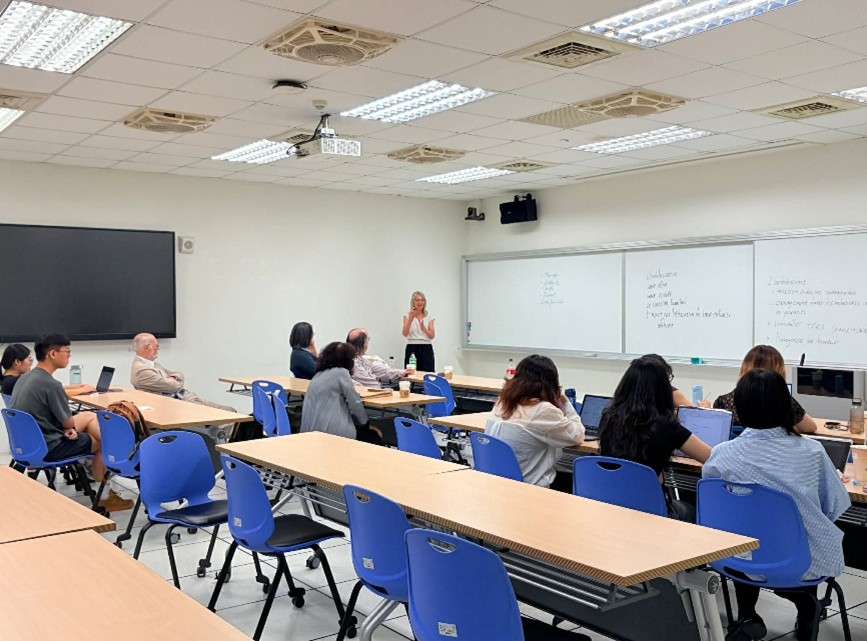
The Department of French at Fu Jen Catholic University (FJCU) recently hosted a distinguished academic series led by Professor Laurence van Ypersele, a prominent historian and professor from the Université catholique de Louvain (UCLouvain), Belgium. Currently directing the prestigious double Master’s degree program between the two institutions, Professor van Ypersele’s visit signifies a renewed commitment to academic excellence within the Francophone community in Asia. This visit reinforces the successful decade-long partnership between UCLouvain and FJCU. Through the leadership of Professor van Ypersele, both institutions continue to pave the way for future academic milestones, ensuring that the study of history remains deeply connected to the lived experiences of individuals and their families.
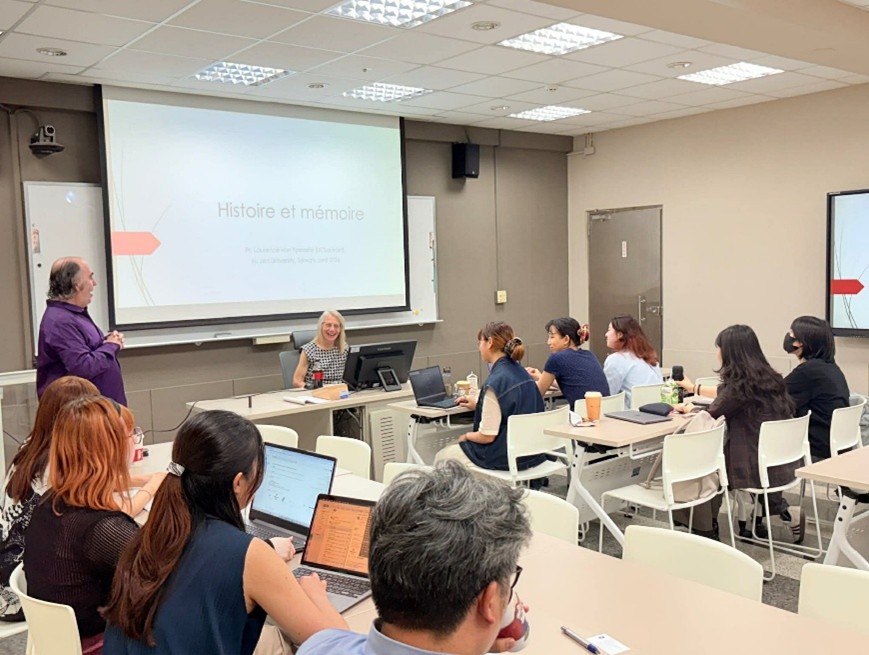
Through this series of workshops for Master's and undergraduate students, Professor van Ypersele explored the complex intersection between "Family, History, and Memory". Her expertise provided students with a rigorous framework to analyze how personal narratives contribute to the broader historical record. The workshop was structured into five distinct sessions, meticulously designed to bridge the gap between family heritage, emotions, cultural and individual identity.
A central pillar of the workshop was the theoretical distinction between "History" as a scientific, universal expert knowledge , and "Memory" as a lay, collective practice rooted in fidelity to one’s ancestors. Professor van Ypersele emphasized that the family serves as the first cell of collective memory , where "official history" and "living memory" constantly negotiate their places.
The first session commenced with a deep dive into the historiography of memory. Professor van Ypersele guided students through the dialectic between History and Memory. This session established the family as the primary unit of collective memory, highlighting the unique role of the "third generation" (grandchildren) as the most effective transmitters of memory, noting that grandparents often confide in them more than in their own children.
The second session consisted of presenting the methodological design of questionnaires, focusing on the technical aspects of research. Students were trained in designing effective questionnaires and mastering the "semi-directive" interview style. This approach ensures that the resulting oral histories are at the same time, both scientifically valid and deeply personal. The third session encourages students to share their knowledge of one’s family’s memory. The students took the floor to share their current knowledge of their own family histories. In a transcultural exchange, students presented research on the evolution of Chinese and Taiwanese family structures, comparing local traditions with the Western models presented by the professor.
The forth session presented the theory of emotions, which will be conducted as a tool while analysing the narratives. A pivotal moment of the workshop was the exploration of "Emotional Regimes". Professor van Ypersele discussed how emotions act as triggers for vivid "Flash Memories”. Resulted in decoding the cultural construction of emotions and perceiving the significance of silence in family narratives.
The final session involved the practical preparation for upcoming fieldwork. Students drafted specific, open-ended questions designed to facilitate storytelling among their relatives. Using tools like mental maps and open-ended questions, students are learning to move from simple anecdotes to a "distanced judgment" that places family stories within their historical context.
The resulting papers will be published on the university website, contributing to a series of academic workshops across Francophone Asia.This project not only enhances scientific research skills but also offers students a profound personal gain by enriching their understanding of their own heritage and identity.


 輔仁大學
輔仁大學
 Facebook
 Instagram
 Youtube
 繁
繁